


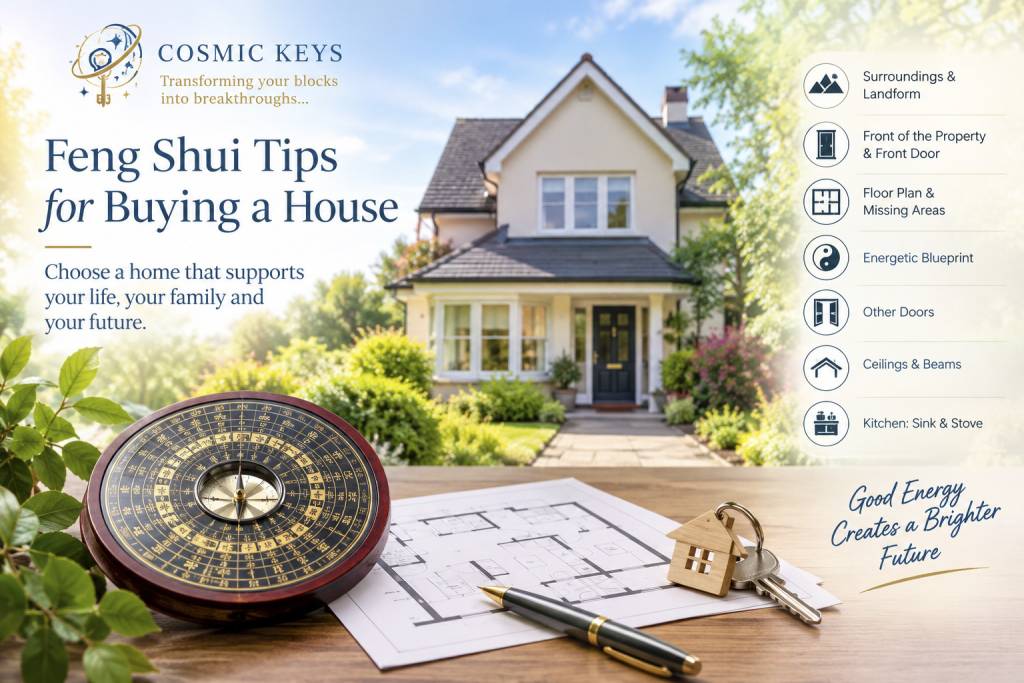
How to Choose a Home with Positive Energy
Buying a house is one of the most important decisions you will make. But beyond location, price, layout and appearance, have you considered how the energy of a property may influence your experience of living there?
In Feng Shui, a home is more than a physical structure. Its surroundings, orientation, entrance, floor plan and internal arrangement are all considered when assessing how the space may support its occupants.
Whether you are buying your first home, moving to a larger property or investing in a new house, applying Feng Shui principles before making a purchase can help you evaluate a property from a different perspective. Feng Shui assess the relationship between a property, its surroundings and the people who live in it. Understanding these factors before you buy can help you make a more informed decision and identify potential challenges before they become costly to address.
Here are the key Feng Shui considerations to explore when buying a house.
1. How Feng Shui Principles Can Help When Buying a House
Traditional Feng Shui considers the relationship between people and their environment. Rather than focusing only on individual rooms or decorative objects, it examines the property as a whole.
When assessing a house before purchase, a Feng Shui practitioner may consider:
- The surrounding landscape and the property’s position within its neighbourhood.
- The orientation of the building and the location of the main entrance.
- The shape and proportions of the floor plan.
- The placement of doors, windows and staircases.
- The arrangement of key rooms, particularly the kitchen and bedrooms.
- The property’s energetic blueprint, based on the chosen Feng Shui methodology.
- The personal energy profile of the intended occupants, where relevant.
A property that looks attractive may still have layout or environmental features worth examining carefully. Equally, a house with an imperfect floor plan may offer opportunities for improvement through thoughtful design and appropriate Feng Shui adjustments.
The aim is not to find a supposedly perfect house, but to understand how well a property may support your lifestyle, priorities and long-term plans.
2. Landform Feng Shui: Assess the Surroundings of the House
One of the most important principles of Feng Shui is that the surrounding environment should be assessed before concentrating on the interior.
Known as Landform Feng Shui, this approach examines the landscape, neighbouring buildings, roads and the way the property sits within its surroundings.
Street location and road alignment
Observe the position of the house in relation to the street.
Consider whether the property sits at a sharp bend, at the end of a T-junction, beside a busy road or close to a road that appears to direct traffic straight towards the entrance.
In Feng Shui, these configurations may be interpreted as affecting the movement and quality of Qi (energy). From a practical perspective, they may also influence noise, privacy, traffic exposure and the overall experience of arriving home.
The important consideration is to assess both the Feng Shui interpretation and the property’s practical surroundings.
The neighbourhood and surrounding buildings
Look beyond the boundaries of the property. Are there open spaces, mature trees, well-maintained neighbouring buildings or a sense of shelter and support?
Traditional Landform Feng Shui values a suitable balance between protection and openness. A property that feels excessively exposed, enclosed or overshadowed may warrant closer examination.
Also consider the general condition of the neighbourhood, access to amenities, natural light, drainage and the property’s maintenance history.
Power cables and electrical infrastructure
High-voltage transmission lines, substations and other major electrical infrastructure or train lines are worth noting during a property assessment.
Do not assume that every overhead cable presents a health hazard. Investigate the specific installation and obtain appropriate professional advice if you have concerns.
Geopathic stress and the land beneath the property
Geopathic stress is a disturbance in the natural resonance of the earth’s natural radiation (7.5 – 8 Hz) which causes a resonance in a building which is uncomfortably fast for the human being to handle. Geopathic stress does not cause disease in and of itself, but it does deplete vitality/immunity and making you more vulnerable to illness.
3. The Front of the Property and the Main Entrance
In Feng Shui, the main entrance is often described as the Mouth of Qi because it is traditionally regarded as an important point through which energy enters the home.
When viewing a property, pay attention to both the external approach and the front door itself.
Ask yourself:
- Is the entrance easy to identify and access?
- Is the approach clear, welcoming and reasonably well maintained?
- Does the front door open fully without obstruction?
- Is the entrance well-lit and in good condition?
- Does the entrance face a staircase, another door or a particularly narrow passage?
The direction a property faces can also be important, particularly in more detailed Feng Shui systems such as Flying Stars Feng Shui.
4. The Position of Internal Doors in Relation to the Front Door
The relationship between the front door and other doors is another feature worth examining during a house viewing.
In Feng Shui, certain door arrangements are believed to influence how Qi moves through a property.
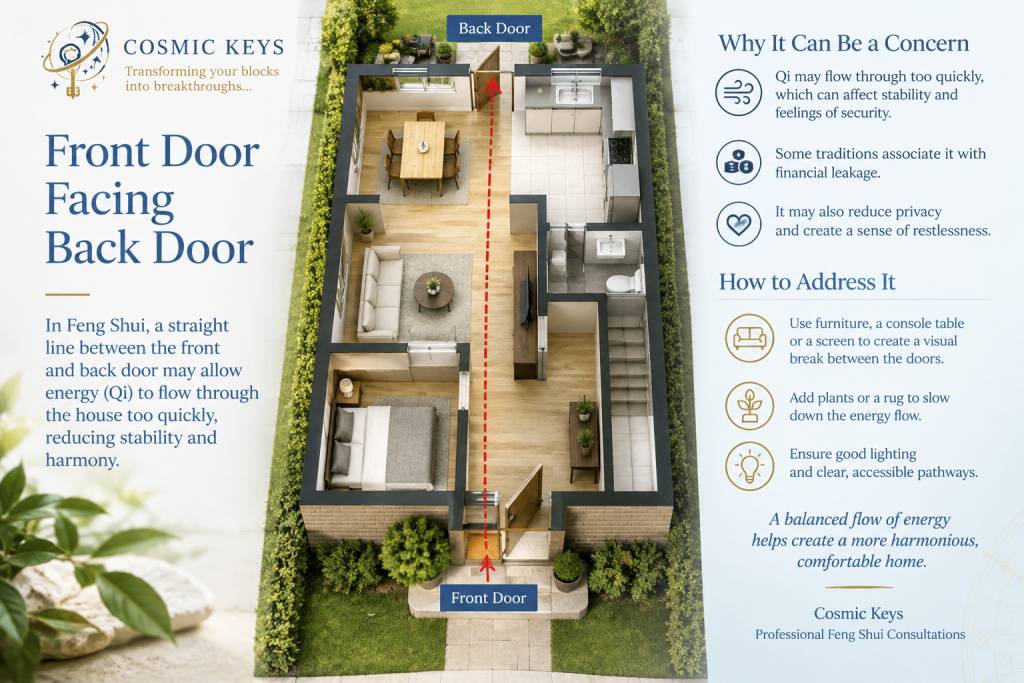
Front door aligned with the back door
If the front door opens directly towards a back door or large rear opening, can be interpreted as a configuration in which energy may pass through the property too quickly.
See the example:
Doors facing each other
Bedroom doors or other internal doors positioned directly opposite each other may also receive attention in a Feng Shui assessment.
Consider how the arrangement affects privacy, movement and the use of the rooms. Where necessary, simple design choices may help create a more comfortable sense of separation.
The goal is to understand the flow of movement through the home and identify any layout issues that could be difficult to change after purchase.
5. Ceilings, Exposed Beams and Structural Features
Ceiling height and overhead structures can influence how a room feels and functions.
A large exposed beam directly above a bed, desk or frequently occupied seating area is often considered a feature worth reviewing. Some practitioners interpret it as creating a sense of pressure or imposing visual energy.
When viewing a property, look for:
- Heavy beams directly above the bed or main seating area.
- Low ceilings or sharply sloping ceilings that restrict usable space.
- Structural features that limit furniture placement.
- Dark corners or rooms that receive little natural light.
- Opportunities to improve the lighting and visual balance.
A beam is not automatically a reason to reject a house. Depending on its position and the room’s layout, furniture can sometimes be rearranged to create a more comfortable space.
However, if the beam or ceiling arrangement is structural and significantly restricts the use of an important room, it is worth understanding the implications before committing to the purchase.
6. Kitchen Feng Shui: The Position of the Sink and Stove
The kitchen is a particularly important area in many Feng Shui traditions because it is associated with nourishment, daily routines and the preparation of food.
Two features to examine are the stove and the sink.
The stove: A traditional symbol of Fire
The stove is associated with the Fire element in Feng Shui. Its position, visibility and surrounding space may be considered as part of the overall kitchen assessment.
The sink: Associated with Water
The kitchen sink is associated with Water, creating a traditional Five Elements consideration when positioned near the stove, which represents Fire.
Feng Shui prefers not to place the sink and stove directly opposite each other or immediately adjacent without sufficient separation. These arrangements are sometimes interpreted as an imbalance between Water and Fire.
7. The Floor Plan: Missing Areas, Extensions and Irregular Shapes
The floor plan is one of the most useful tools in a Feng Shui house assessment.
In many Feng Shui methods, the property’s overall shape is divided into nine sectors using a Bagua framework. Each sector is associated with particular life themes and, in traditional practice, with specific directional and elemental relationships.
A square or rectangular floor plan may make this analysis more straightforward. However, many UK houses have extensions, bay windows, garages, L-shaped layouts or irregular boundaries.
What are missing areas in Feng Shui?
A missing area generally refers to a sector that falls outside the main footprint of an irregularly shaped property when the chosen Bagua method is applied.
Within traditional Feng Shui, missing sectors may be interpreted as areas requiring additional attention.
Before purchasing a property, examine:
- Whether the floor plan is broadly regular or has significant indentations.
- Whether an extension changes the overall shape.
- Whether any sector appears significantly reduced or absent.
- Whether the layout offers practical scope for improvement.
A professional assessment can help clarify which floor-plan method is appropriate and whether the property’s shape presents any meaningful design considerations.
8. The Energetic Blueprint: Understanding the Property’s Feng Shui Chart
Two houses with similar layouts can have different Feng Shui charts.
In Flying Stars Feng Shui, for example, a property’s orientation, facing and sitting directions, time period and other relevant factors are used to construct a chart. The resulting arrangement of stars is interpreted according to the methodology being followed.
This chart is sometimes described as the property’s energetic blueprint.
It can be used to examine how different sectors are traditionally interpreted in relation to themes such as prosperity, relationships, wellbeing and activity.
When buying a house, a practitioner may consider:
- The property’s facing direction and sitting orientation.
- The relevant time period under the chosen Flying Stars method.
- The placement of the main entrance and frequently used rooms.
- The location of bedrooms, the kitchen and the home office.
- Which sectors may require careful management and which may be suitable for particular activities.
Understanding a property’s energetic blueprint before purchase may help you compare two otherwise similar houses and identify considerations that would not be apparent from photographs alone.
9. Consider the Needs of the People Who Will Live There
Feng Shui assessments can also consider the people who will occupy the property.
Depending on the system used, a practitioner may incorporate personal directions, Life Gua, BaZi (Four Pillars of Destiny) or other traditional Chinese metaphysical methods.
For example, the most suitable bedroom, desk position or room arrangement may be assessed in relation to the occupants’ individual profiles and practical needs.
This is particularly relevant when buying a family home, choosing a property for retirement or creating a dedicated home office.
A home should work for the people living in it, not simply conform to a theoretical chart.
10. Should You Get a Feng Shui Assessment Before Buying a House?
A professional assessment can help you look beyond surface appearance and consider the property in greater detail.
It is helpful to carry out this assessment early enough to inform your decision. If a property’s layout would require expensive structural changes to suit your needs, knowing this before purchase may help you compare the overall value of your options.
At Cosmic Keys, we believe that you cannot always change the building, but you can understand how it works for you.
Planning to Buy a House? Let Cosmic Keys Help You Look Beyond the Floor Plan.
A professional Feng Shui consultation can help you assess the property, understand its layout and identify areas that may benefit from careful consideration before you commit to a purchase.
Whether you are buying a family home, moving to a new property or exploring an investment, Cosmic Keys can help you approach your decision with greater clarity.
Contact Cosmic Keys to enquire about a pre-purchase Feng Shui consultation.
Website: https://www.cosmickeys.org
Email: asmita@cosmickeys.org
Telephone: +44 7832 130911
Cosmic Keys — Transforming your blocks into breakthroughs.

